A Sweet Vigorosa rose flowers throughout the summer and is easy to grow.
Garden Chores for July

A white rose after the rain. Photo courtesy of my daughter, Aphrodite.
In This Issue

This unusual hydrangea is called Lemon Wave, Hydrangea macrophylla 'Lemon Wave' at Alison's garden.
Drought Gardening
Watering Tips & Techniques
July Garden Stars - July Garden Chores - July Garden Beds - Hungry Plants - Weeds - July Lawn Care
Pruning in July - Summer Rose Care - Vegetable Gardening - Tomatoes - Tomato & Potato Blight
Winter Vegetable Gardening - Helping Pollinators - Summer Composting - Powdery Mildew
Container Growing in July - July Flower Arrangement - Plant of the Month: Catalpas
Watering Tips & Techniques
July Garden Stars - July Garden Chores - July Garden Beds - Hungry Plants - Weeds - July Lawn Care
Pruning in July - Summer Rose Care - Vegetable Gardening - Tomatoes - Tomato & Potato Blight
Winter Vegetable Gardening - Helping Pollinators - Summer Composting - Powdery Mildew
Container Growing in July - July Flower Arrangement - Plant of the Month: Catalpas
Fellow Gardeners..
A treasured giant horsechestnut tree at Riverview Arboretum.
Hello Fellow Gardeners,
It's probably no surprise that I’m a big fan of trees, especially big old ones, so when I saw a Facebook posting of a tree tour at Riverview Arboretum, guided by horticulturist Derek Churchill, I was eager to join. I’ve been to the arboretum several times throughout the years, and I’ve always been impressed. These trees originated from all over the world and date back to the early 1900’s. The 244 acre property surrounds Riverview Hospital. It was in 1911 the arboretum was established by botanist John Davidson. Many of the trees planted back then are still alive thanks to The Riverview Horticultural Society. This non-profit society’s volunteers are the bastions and caregivers of the more than 1,800 tree specimens on the property. BC Housing and the Kwikwetlem First Nation own this prime land that's been threatened by commercial and residential development – perish the thought. Since the Riverview Horticultural Centre Society is non-profit, it can’t survive without the generosity of tree lovers - either by donation or by volunteering. Join in one one of the many scheduled tree tours offered throughout the year. Become a member and be privy to their events and latest updates. The membership fee is only $5.00 for the year. Check out my post and pics from the tree tour on my Facebook Page. Cheers, Amanda 
A giant weeping beech.
|
Subscribe!

Click on the picture to subscribe.
Water Restrictions
Watering lawns in Metro Vancouver is allowed only one day a week but not so for the garden and veggie patch.
STAGE 1: Lawn watering is restricted to one day a week, but water trees, shrubs and flowers is permitted any day from 5 am to 9 am if using a sprinkler, or any time if hand watering or using drip irrigation. Edible plants (veggies, fruits and herbs) are exempt from regulations. Click on Metro Vancouver for details.
Garden Clubs
The BC Fuchsia and Begonia Society promotes fuchsias, begonias, ferns and other shade-loving plants. The society meets at 7pm, 3rd Wednesday each month at St. Timothy's Church Hall, 4550 Kitchener Street. They offer knowledgeable speakers, plant displays, plant sales, refreshments and friendship. Click on Fuchsias & Begonias to learn more.
|
July Garden Stars

Feverfew, Tanacetum parthenium, short-lived herbaceous perennial, 1’-3’x1’-2’, sun, self seeds. USDA Zones 5 to 8.
|
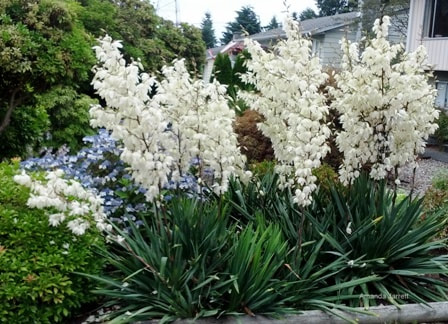
Adam’s needle, Yucca filamentosa, broadleaf evergreen, June to July, 4’ to 8’ x 2’ to 3’, sun, attracts butterflies. Zones 5 to 10.
|

Dappled willow, Salix integra 'Hakuro Nishiki', deciduous grafted shrub, colourful foliage, 4' - 6' x 5 to 7ft, sun to part shade. Zones 5 to 7.
|

Delphinium, herbaceous perennial, 4’-6’ x 2’-3’, flowers from June to July, attracts hummingbirds and butterflies, needs good drainage and full sun. Zones 3 to 7. Click on pic for more.
|

Tutsan, sweet-amber, Hypericum androsaemum, deciduous shrub, 2-3’, sun, part shade, yellow blooms, red berries, drought tolerant. Zones 5 to 8.
|

Oakleaf hydrangea, Hydrangea quercifolia, deciduous shrub, 6' to 8' tall and wide, flowers mature to pink and persist into winter, plum fall foliage colour, sun to part shade. Zones 5 to 9.
|

Lucifer montbretia, Crocosmia 'Lucifer', herbaceous perennial, sun to part shade, 2 - 3' x 1 - 2', butterflies, hummingbirds. Zones 5 to 9.
|

Sweet pepperbush/summersweet, Clethra alnifolia 'Vanilla Spice', fragrant deciduous shrub, 3' to 6' tall & wide, likes moist soil, sun to part shade. Zones 4 to 8.
|

English lavender (Lavandula angustifolia), semi-evergreen sub-shrub, fragrant, sun, 1 -3’, bees, butterflies. Zones 5 to 9. Click on the pic for more.
|
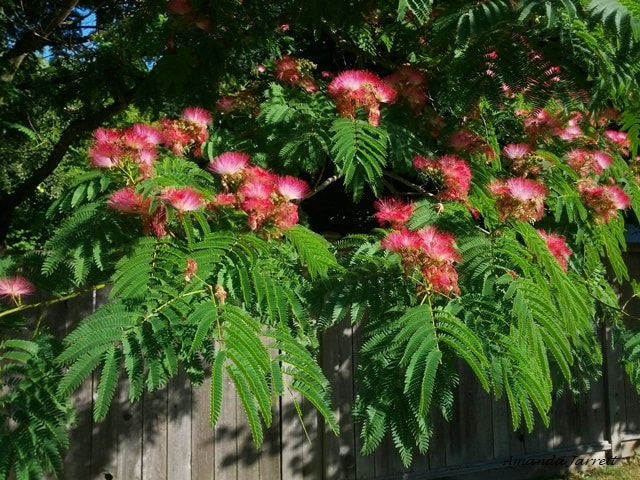
Persian silk tree/mimosa, Albizia julibrissin, deciduous tree, 16 to 52', fragrant, sun and dry soil. Zones 6 to 9. Click on the pic for more.
|
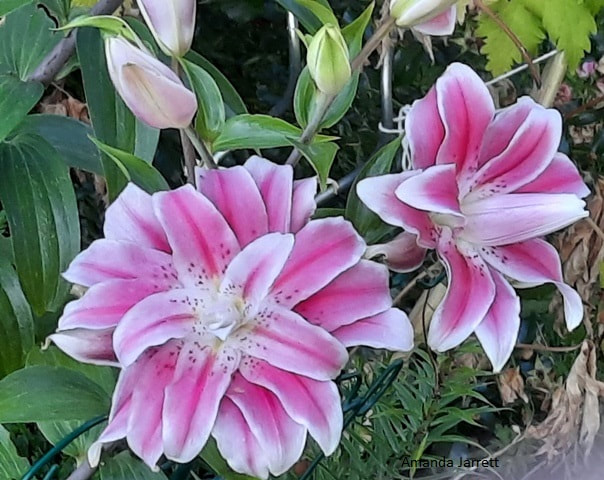
Sweet Rosy Oriental hybrid lily, summer flowering bulb, 32-44”, sun, part shade, fragrant. Zones 3-8
|
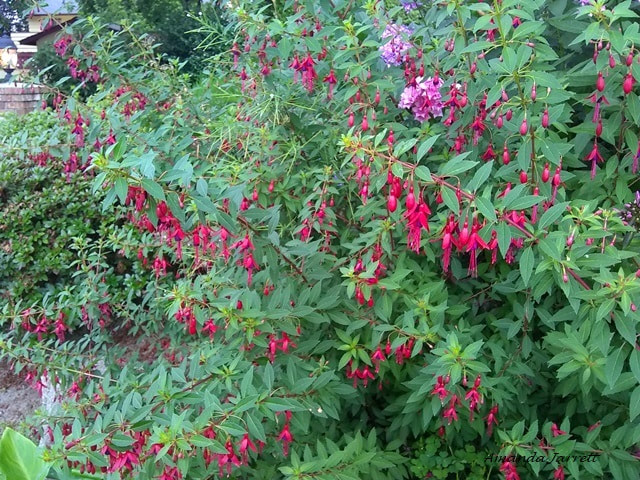
Hardy Fuchsia, F. magellanica, tender deciduous shrub, 4' to 8' , partial shade, butterflies, hummingbirds. Zones 6 to 9.
|
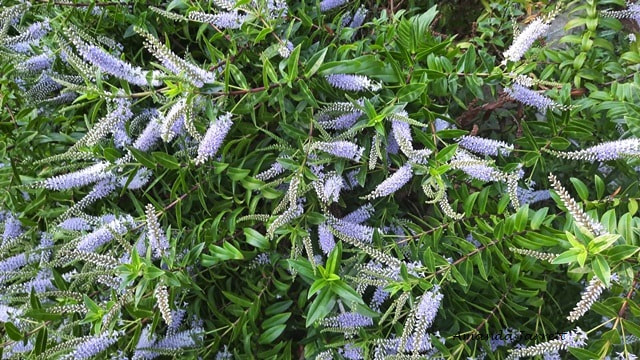
Patty's Purple hebe, H. buxifolia 'Patty's Purple', broadleaf evergreen shrub, sun, 2'-3' x 1-2'. Zones 9 to 10.
|

Cape fuchsia, Phygelius capensis, herbaceous perennial or sub shrub, summer flowers into fall, 2’–3’ x 2’, sun to part shade, yellow or pink, attracts hummingbirds. Zones 6 to 9
|

Shasta daisy, Leucanthemum × superbum, herbaceous perennial, 18” to 2’ x 12” to 18”, attracts butterflies, sun to part shade. Zones 4 to 9.
|

Peruvian lily, Alstroemeria, tuberous herbaceous perennial, sun to part sun, 1 -3’ x 1 -2’. Zones 8 to 10. Click on the pic for more.
|

‘Black Lace’ elderberry, Sambucus nigra, deciduous shrub, 6’-8’, fragrant, June, July, black edible berries, sun to part shade, butterflies, birds. Zones 4 to 7. Click on pic for more.
|

Bear's breeches, Acanthus mollis, herbaceous perennial, 3’-5’ x 2-3’, blooms June to July, sun to part shade, thorns, attractive foliage. Zones 7 to 11. Click on the pic for more.
|

Astilbes, herbaceous perennials, 6in to 4ft, moist shade. Zones 3 to 8. Click on the pic for more.
|

Daylily, Hemerocallis spp., herbaceous perennial, 10”-12” tall & wide, sun, part shade, repeat fragrant blooms. Zones 2 to 9. Click on pic for more.
|

Yellow wax bells, Kirengeshoma palmata, herbaceous perennials, 3’ to 4’ x 2’ to 3’, June to July, part to full shade. Zones 5 to 8.
|

'Royal Purple' smokebush, Cotinus coggygria 'Royal Purple', deciduous shrub, purple summer foliage & flowers, fall colour, 10-15’ x 15’- 20’. Sun to part shade. Zones 4 to 8
|

Lychnis coronaria, catchfly, rose campion, evergreen herbaceous perennial, 2 to 3 ft, sun, May to July, drought tolerant, self-sows. Zones 4 to 8.
|

Betony, Stachys monieri 'Hummelo', herbaceous perennial, 1.5 to 2 ft., July to September, sun. Zones 4 to 8.
|

Kousa dogwood, Cornus kousa, deciduous tree, 15-24’ x 15-20’, fall colour, reddish tasteless but edible fruit, sun to light shade. Zones 5-8.
|
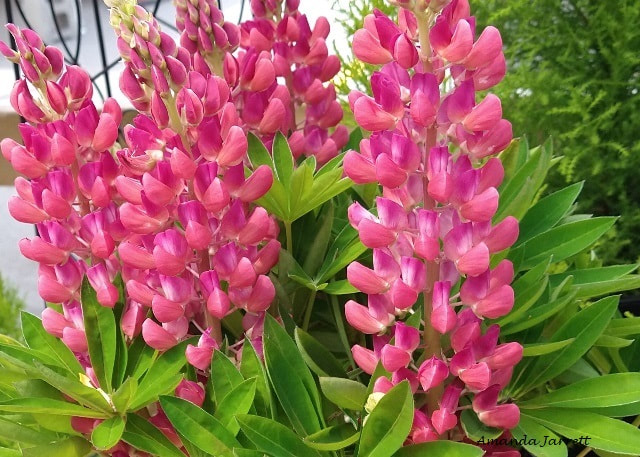
Lupins, Lupinus x hybridus, herbaceous perennial, 3’ – 4’ x 1’ – 1.5’, flowers May to July, sun, attracts butterflies. Zones 4 to 8.
|

Japanese Stewartia, Stewartia pseudocamellia, deciduous tree, 20 - 40' x 10 - 25', sun, part shade, June to July. Zones 5-8. Click on the pic for more.
|
July Garden Chores
Click on the coloured links to be redirected.

A large gunnera at Warwick Castle on a sunny day in July.
Check on your garden: Your garden needs you more than ever during the summer. The heat and lack of rain makes plants vulnerable to insects and diseases in their weakened state. Tempting as it is to kill all the plant eating bugs with insecticides, what’s more important is to make sure they are receiving adequate amounts of water and provide shade to heat stressed. To learn what to look for when inspecting your garden click on Garden Inspections.

Black sooty mold on a camellia. Click on pic for more info.
|

Japanese beetle damage on a bean leaf. Click on pic for more.
|

Too much sun has burned this fern frond.
|
Water Restrictions: In Metro Vancouver it is a misconception that you can only water once a week, but that is only for the lawn, not the garden beds, veggie gardens and other edibles. Currently, watering trees, shrubs and flowers is permitted any day from 5 am to 9 am if using a sprinkler, or any time if hand watering or using drip irrigation.
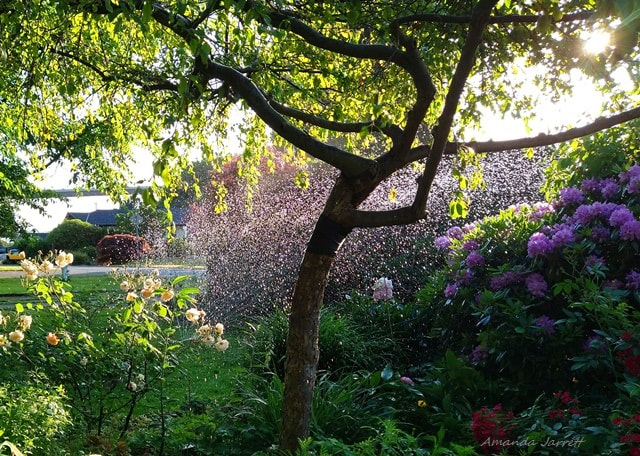
Sprinklers on gardens is permitted any day from 5 am to 9 am.
|
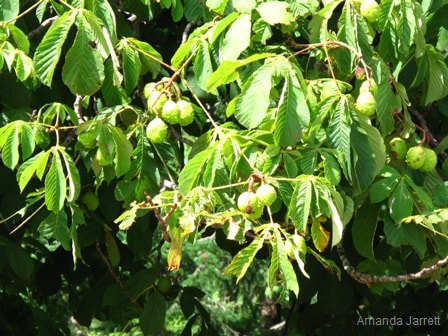
This wilted horse chestnut tree needs a good long soak.
|

Watering lawns is permitted only one day a week so make it count.
|
Watering: It’s a fact that the higher the temperature the quicker the drier the soil. Check on garden beds, hanging baskets and planters daily and water when necessary. Water wilted plants immediately. The longer they suffer the weaker they become, encouraging insects, diseases and an untimely death.
Water Properly: Avoid giving plants just a bit of water as this leads to shallow roots instead of long, deep roots, which handle heat and drought much better. Give plants and surrounding soil long soaks so the water puddles then drains away. Repeat until the water has penetrated down to at least 4 inches. Here's more on Watering Tips & Techniques.
Water Properly: Avoid giving plants just a bit of water as this leads to shallow roots instead of long, deep roots, which handle heat and drought much better. Give plants and surrounding soil long soaks so the water puddles then drains away. Repeat until the water has penetrated down to at least 4 inches. Here's more on Watering Tips & Techniques.

A wilted phlox is begging for a drink
|

When watering give plants a deep, long soak.
|

Don't wait to water wilted plants.
|
Edible plants (veggies, fruits and herbs) are exempt from water restrictions. Click on Metro Vancouver Water Restrictions for details.
Trees and shrubs: Don’t forget to water your trees, shrubs, hedges, including cedars and any street trees in front of your property - they need water too! Water the entire perimeter of the plants’ canopy (dripline) so the soil becomes thoroughly moist.
Trees and shrubs: Don’t forget to water your trees, shrubs, hedges, including cedars and any street trees in front of your property - they need water too! Water the entire perimeter of the plants’ canopy (dripline) so the soil becomes thoroughly moist.
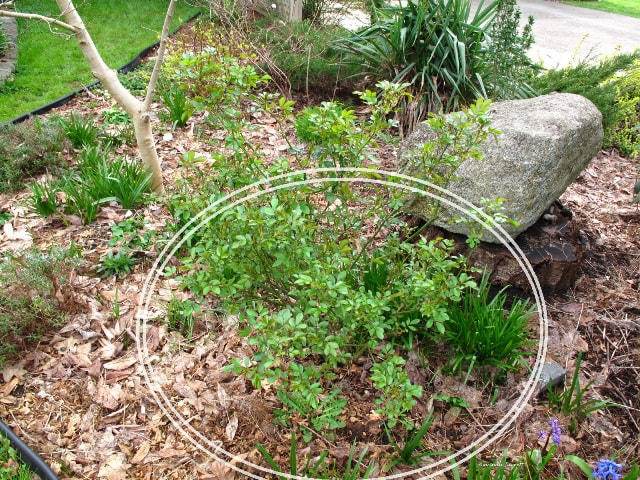
Water shrubs along their dripline and beyond.
|

Water along a tree's dripline, not the tree trunk.
|

Edible gardens don't have any water restrictions in Metro Vancouver.
|
Hand watering: Don’t just water the plant, water the entire area to moisten the surrounding soil. Dry soil acts like a wick that draws water away from plant roots. Allow the water to puddle a couple of times before going to the next area.
Soaker hoses & drip systems: Check plants and soil often to ensure that plant roots are thoroughly moistened. If not, hand watering is an efficient way to take up the slack. Note that drip and soaker hose systems emit just a small amount of water so they must be placed strategically at the base of plants. Don’t skimp, use numerous soaker hoses placed close together as seepage is slow to spread through the soil. Drip irrigation systems work well for containers and patio planters but do check on them to ensure plants are receiving adequate water.
Soaker hoses & drip systems: Check plants and soil often to ensure that plant roots are thoroughly moistened. If not, hand watering is an efficient way to take up the slack. Note that drip and soaker hose systems emit just a small amount of water so they must be placed strategically at the base of plants. Don’t skimp, use numerous soaker hoses placed close together as seepage is slow to spread through the soil. Drip irrigation systems work well for containers and patio planters but do check on them to ensure plants are receiving adequate water.

Don't rely on drip and soaker hoses to keep plants hydrated in the summer.
|

A vineyard used a drip system to aid in irrigation.
|
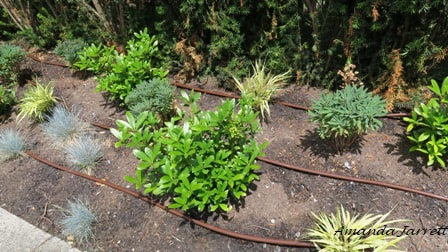
Use more than one drip line to make drip systems more effective.
|
Reduce watering: The simplest way to keep the soil moist is to apply a three inch layer of organic mulch on top of the soil and around plants. It really does work as it stops the water from evaporating from the soil. Mulch also stops weeds and keeps the soil cooler during the summer months and warmer in the winter months. Gotta love mulch! To learn all about the different types of mulches and their benefits click on Mulch.
To learn how to water more efficiently and effectively click on Watering Tips & Techniques. To make your garden more water efficient during the summer click on Drought Gardening.
To learn how to water more efficiently and effectively click on Watering Tips & Techniques. To make your garden more water efficient during the summer click on Drought Gardening.

Water quickly evaporates from bare soil leaving it to dry right out.
|

Mulch protects the soil from evaporation, reducing watering.
|

Plant selection is an important step in gardening for drought.
|
Wilted plants that aren’t thirsty: It’s often confusing as to why plants wilt when they have plenty of water. It’s not a lack of water that’s making them droop, it’s the heat and sun; they are just too darned hot. Keep plants cooler by shading them with an umbrella, a covered trellis etc.
Wait to Plant: Planting and transplanting during the summer is often not successful due to the high temperatures and lack of rain. Wait until autumn when it’s cooler and wetter.
Wait to Plant: Planting and transplanting during the summer is often not successful due to the high temperatures and lack of rain. Wait until autumn when it’s cooler and wetter.

These leaves turned crispy brown because of heat & drought.
|

Sun damage on a camellia.
|

Sunscald on hosta leaves.
|

Temporary shade saves plants.
|
Garden Beds: Some plants will be enjoying the long, hot days and lack of rain: Japanese spireas, lantanas, sunflowers, coneflowers, salvias, echinacea, hibiscus, coreopsis, dahlias, sedums, asters, lilies, daylilies, lavenders, catnip, shasta daisies and mums. However, there are many plants, especially shade loving plants, that fail to compete with their hot neighbours. They become overtaken and struggle to survive without sun and space to grow so cut back encroaching stems from neighbouring plants. Don’t do any transplanting until fall when it is cooler and the rain returns.

There's a rose hidden by a spurge and dahlia foliage.
|

After the spurge was removed.
|

I cut back the interfering dahlia leaves, but not the stems.
|

The poor suffering rose should bounce back.
|
Hungry Plants? Yellow foliage and weak growth are common signs of hunger. Hungry plants are prone to insects and diseases so feed them with nitrogen fertilizer (high first number ex: 5-2-3) such as kelp or fish or use compost. For more on fertilizing select Feeding Plants 101 - Fertilizers & Ratios - Nutritional Deficiencies & Toxicities - Organic Plant Food
Remedial Staking: Continue to support vines, dahlias and tomatoes as they oftentimes run amok and even collapse with adequate support and training. Remove stakes from gladiolus, peonies, delphiniums and other plants once they no longer need them. Prop up balloon flowers, lilies and other tall, top heavy that flop over with a suitable sized trellis from a dollar store for a quick fix.
Remedial Staking: Continue to support vines, dahlias and tomatoes as they oftentimes run amok and even collapse with adequate support and training. Remove stakes from gladiolus, peonies, delphiniums and other plants once they no longer need them. Prop up balloon flowers, lilies and other tall, top heavy that flop over with a suitable sized trellis from a dollar store for a quick fix.

A container grown tomato has run out of food.
|

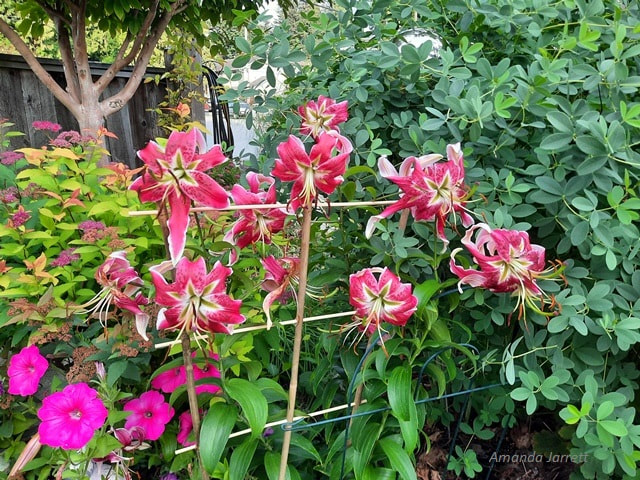
A simple bamboo trellis from the dollar store helps keep these Black Beauty lilies upright.
|
Weeds: To make hand weeding easier, do so after it has rained or water the soil thoroughly beforehand. Pulling weeds is instant and more efficient than waiting for herbicides to work. Herbicides need repeat applications for the roots to permanently die and their spray drift will injure desirable plants. Once the area is weeded, add a 3 inch layer of mulch to deter more weeds from growing.

It doesn't take long for weeds to invade a rock mulch.
|

A thick layer of woodchips prevents weeds from growing in Alison's garden.
|
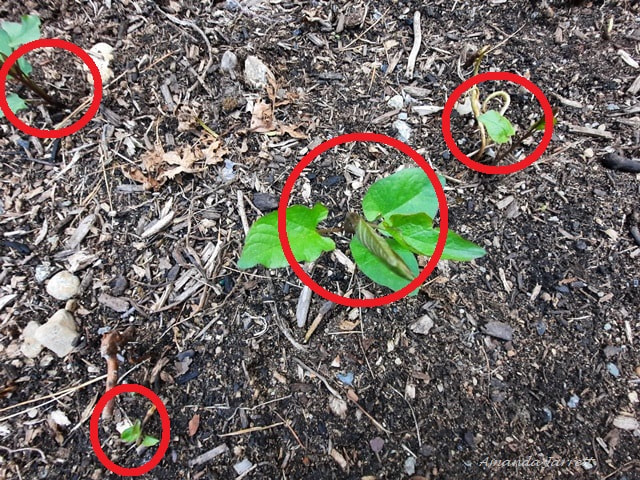
Bindweed spreads if dug up, so pull out each plant instead.
|

Weeds have run amok!
|
Bedding Plants/Annuals: To revive tired petunias, impatiens and other annuals, cut stems back by half. Follow up with a drink and some organic plant food to speed their recovery.
Peony Leaf Blotch (aka peony measles): Dark brown splotches on peony leaves is a symptom of peony measles. There is no control for this common peony disease control, just remove and discard infected leaves before winter. Click here for more.
Peony Leaf Blotch (aka peony measles): Dark brown splotches on peony leaves is a symptom of peony measles. There is no control for this common peony disease control, just remove and discard infected leaves before winter. Click here for more.

Remove the entire blossom & its stem when deadheading petunias.
|

Cut all stems back on petunias to encourage more flowers and to prolong their life.
|
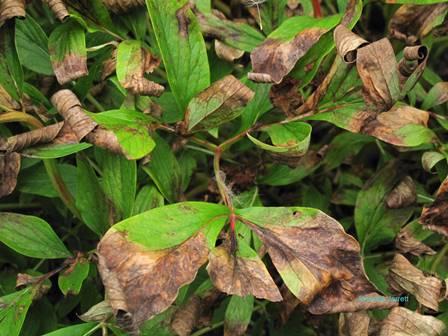
Don't add infected peony leaves to the compost.
|
Lawns: Our northern lawns prefer the cool, wet weather of spring and fall and go semi-dormant during the summer. All lawns need is an inch of water a week to keep the lawn grubs at bay, reduce weeds and to keep them alive. In Metro Vancouver, watering lawns is restricted to one day a week. Make the most of that day by putting the sprinkler on for one full hour. Fertilize hungry lawns that haven’t been fed with a high nitrogen fertilizer (10-2-4). Don’t apply fertilizer to lawns that haven’t been watered and are yellow from drought.
Mowing: Don’t cut it too short! Set your mower to 3 inches, mow often so you don't have to rake or bag the clippings.
Lawn Renovations: Wait until autumn when the weather is cooler and wetter to renovate and install new lawns.
Lawn Care Basics - Lawn Maintenance Schedule - Mossy Lawns - Lawn Reno, Seed & Sod - Lawn Grub Control - Lawn Alternatives
Mowing: Don’t cut it too short! Set your mower to 3 inches, mow often so you don't have to rake or bag the clippings.
Lawn Renovations: Wait until autumn when the weather is cooler and wetter to renovate and install new lawns.
Lawn Care Basics - Lawn Maintenance Schedule - Mossy Lawns - Lawn Reno, Seed & Sod - Lawn Grub Control - Lawn Alternatives

Weeds survived not being watered over the summer. This lawn wasn't so lucky.
|

Racoons and birds are nature's chafer beetle control patrol at the expense of the lawn.
|

Keep the grass longer during from 3 to 4 inches.
|

Lawns cut too short can't handle heat, drought and encourages lawn grubs.
|
Pruning: Summer pruning of trees, shrubs and vines relieves them of any errant, broken, dead, diseased stems including watersprouts and suckers. It also initiates flowers on wisterias, evergreen clematis and fruit on apple and other fruit trees. Here's more detail on pruning: Pruning Basics 101 - Pruning Tools
Pruning clematis: If your clematis doesn’t flower, it could be because you are cutting it back at the wrong time of year. When to cut back clematis depends on what type it is. If you don’t know which ones you have, don’t prune them. To learn more about pruning clematis click on Pruning Clematis.
Pruning Hedges: Trim hedges around the end of July and the beginning of September - at the very, very latest in the South Coast of BC, Zone 8. Preferably it should be done by late August. For those living farther north, get it done by the beginning of August. This gives the plants time to harden off the new growth before winter arrives.
Pruning clematis: If your clematis doesn’t flower, it could be because you are cutting it back at the wrong time of year. When to cut back clematis depends on what type it is. If you don’t know which ones you have, don’t prune them. To learn more about pruning clematis click on Pruning Clematis.
Pruning Hedges: Trim hedges around the end of July and the beginning of September - at the very, very latest in the South Coast of BC, Zone 8. Preferably it should be done by late August. For those living farther north, get it done by the beginning of August. This gives the plants time to harden off the new growth before winter arrives.
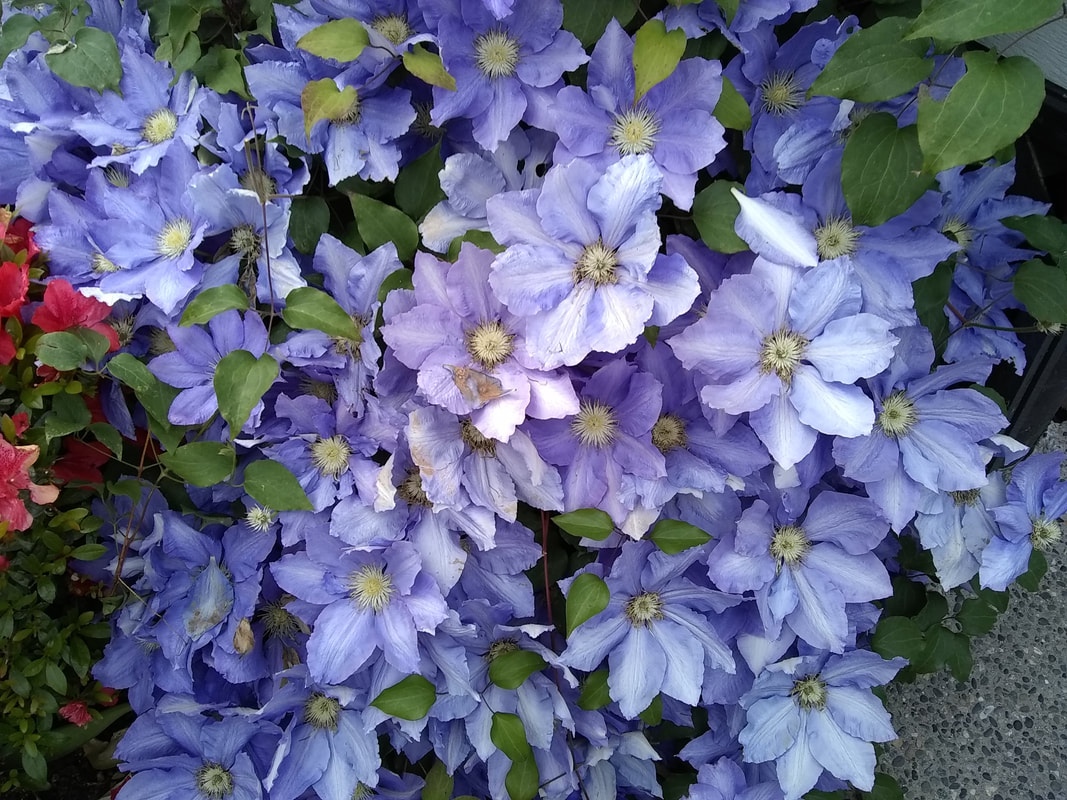
When to prune clematis depends on the type.
|

Trim hedges this month.
|

Remove all dead branches from trees and shrubs.
|
Grafted plants: Roses, fruit trees, weeping and dwarf trees are the union of two or sometimes three plants grafted together. Remove any growth that emerges below the graft union. Those shoots are emerging from the rootstock. They look different and usually are more vigorous compared to the rest of the plant.
Apple Trees: To create fruiting spurs cut back side branches to 2 to 4 buds (nodes). The remaining shortened stem will revert to a fruiting spur in a couple of years. Thin crowded fruit clusters so they don’t touch, and any misshapen, small, dead or diseased fruit. Remove all suckers and watersprouts.
Grape Vines: Cut back all side stems to 2 to 4 buds (nodes). To harvest larger grapes but fewer fruit clusters, thin the clusters so they are a foot apart. Remove any small, misshapen, diseased and dead fruit. For more information on pruning grapes click on Pruning Grapes.
Apple Trees: To create fruiting spurs cut back side branches to 2 to 4 buds (nodes). The remaining shortened stem will revert to a fruiting spur in a couple of years. Thin crowded fruit clusters so they don’t touch, and any misshapen, small, dead or diseased fruit. Remove all suckers and watersprouts.
Grape Vines: Cut back all side stems to 2 to 4 buds (nodes). To harvest larger grapes but fewer fruit clusters, thin the clusters so they are a foot apart. Remove any small, misshapen, diseased and dead fruit. For more information on pruning grapes click on Pruning Grapes.

The green rootstock is taking over the purple witch hazel.
|

Tame wisterias & promote flowers by cutting all side shoots to a couple of buds.
|
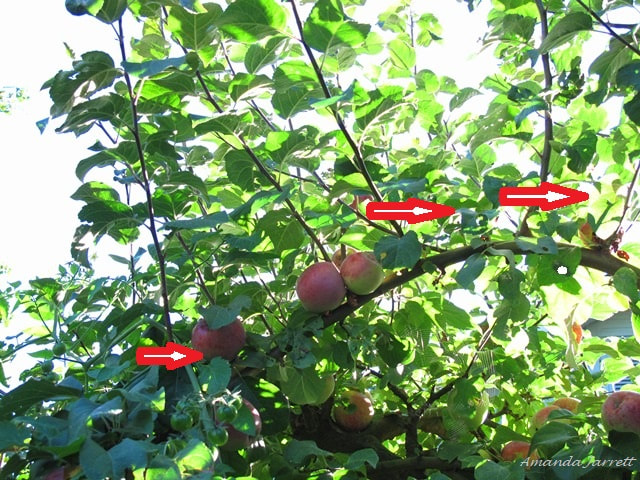
Cut back side shoots on apple trees to create fruiting spurs
|

Thin fruit clusters for bigger and healthier fruit.
|

Thin grape clusters for faster ripening and bigger, healthier grapes.
|
Suckers & Watersprouts: Pull them off if they are small or cut them off flush to the branches. Don’t leave any remaining stub to prevent regrowth.
Pruning Shrubs: Wait until they finish flowering before cutting them back and doing any thinning. Remove spindly, weak, old and dead stems and ones that grow towards the centre of the plant. Finish off by cutting back the remaining stems by a third. Cut just above an outward facing node (bud, leaf) so any new growth will grow away from the inside of the plant.
After Pruning: Give all your pruned plant patients a nice long drink so they can recover from surgery. To replace the lost limbs and foliage, feed plants some kelp, fish, compost or another organic fertilizer high in nitrogen (the first number).
For more on pruning click on Pruning Basics 101 - Pruning Tools. Do you want to learn how to prune? Learn how in your own garden with Amanda, click on Prune Your Own Garden to register.
Pruning Shrubs: Wait until they finish flowering before cutting them back and doing any thinning. Remove spindly, weak, old and dead stems and ones that grow towards the centre of the plant. Finish off by cutting back the remaining stems by a third. Cut just above an outward facing node (bud, leaf) so any new growth will grow away from the inside of the plant.
After Pruning: Give all your pruned plant patients a nice long drink so they can recover from surgery. To replace the lost limbs and foliage, feed plants some kelp, fish, compost or another organic fertilizer high in nitrogen (the first number).
For more on pruning click on Pruning Basics 101 - Pruning Tools. Do you want to learn how to prune? Learn how in your own garden with Amanda, click on Prune Your Own Garden to register.
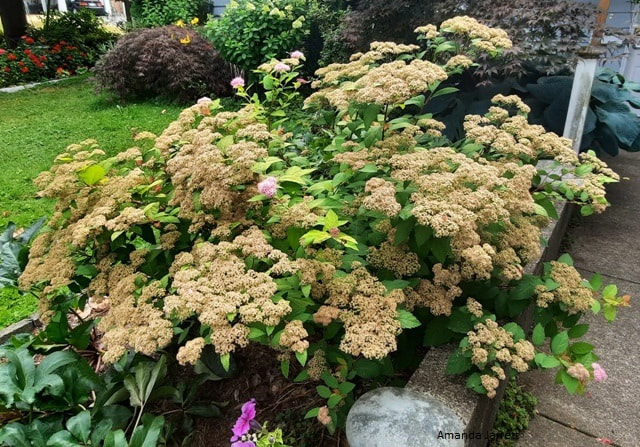
Cut back flowering shrubs once they finish flowering. Japanese spirea pictured.
|

Only cut shrubs back by one quarter this time of year.
|

Remove ALL suckers from the base of trees.
|

Remove suckers and the stub where they grew from.
|
July Veggie Gardens Daily visits to the veggie garden is a must to harvest, weed, water thirsty plants (Vancouver water restrictions don’t include edibles), fertilize hungry crops, control plant eating bugs. If weeds and frequent watering is an issue use a layer of straw as a mulch between plants. Torn up newspapers also are effective.
Harvest: Daily harvesting ensures fresh produce picked at their prime. Small zucchinis may not look impressive, but they are much tastier than giant ones. To learn more about when to harvest crops click here.
Harvest: Daily harvesting ensures fresh produce picked at their prime. Small zucchinis may not look impressive, but they are much tastier than giant ones. To learn more about when to harvest crops click here.

Check out your veggie garden daily.
|
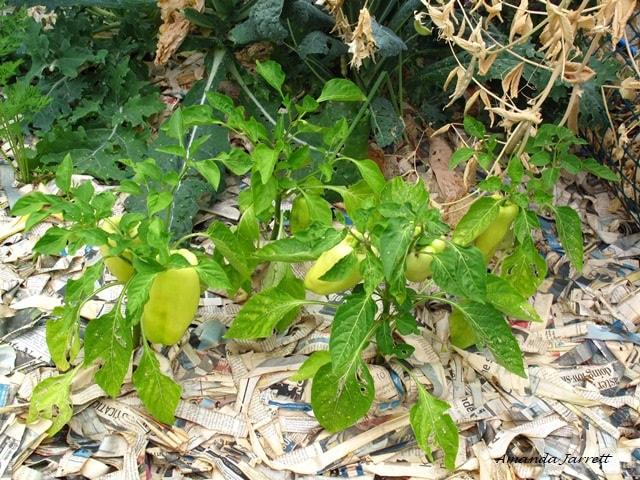
Mulch veggie beds with straw or newspapers.
|

A bountiful harvest.
|

This cauliflower has passed its prime and is ready to compost.
|
Tomatoes: To encourage healthy, delicious fruit and to encourage ripening, cut back overly long stems just above a fruit or flower cluster. Remove suckers at the junction where leaves join the stems. Cut back leaves that shade the ripening tomatoes. To promote plant health and ripening mix 1 to 2 tablespoons of Epsom salts in one gallon of water. Apply as a soil drench or mist the foliage with the solution for quicker results.
Keep soil evenly moist to prevent fruit from cracking and blossom end rot. Keep water off the foliage to prevent diseases and keep water off the leaves especially before nightfall. Lack of flowers is caused by too much nitrogen fertilizer and/or too much shade. To promote flowers, apply a high phosphorous fertilizer (high middle number). Toms need at least 6 hours of direct sunlight a day. If aphids are a problem, wash them off with your fingers and water and ease up on the nitrogen fertilizer and manures.
There's lots to learn about tomatoes. Here's some links you might find helpful: Tomato Tips - The Life of Tomato Seedlings to Plants -Taming Tomatoes - Speeding up Tomato Harvest -Tomato Troubles - Saving Tomato Seeds - The Trouble with Tomatoes
Keep soil evenly moist to prevent fruit from cracking and blossom end rot. Keep water off the foliage to prevent diseases and keep water off the leaves especially before nightfall. Lack of flowers is caused by too much nitrogen fertilizer and/or too much shade. To promote flowers, apply a high phosphorous fertilizer (high middle number). Toms need at least 6 hours of direct sunlight a day. If aphids are a problem, wash them off with your fingers and water and ease up on the nitrogen fertilizer and manures.
There's lots to learn about tomatoes. Here's some links you might find helpful: Tomato Tips - The Life of Tomato Seedlings to Plants -Taming Tomatoes - Speeding up Tomato Harvest -Tomato Troubles - Saving Tomato Seeds - The Trouble with Tomatoes

Remove suckers from tomatoes.
|
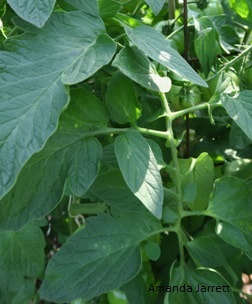
Where are all the tomatoes?
|

Oh there they are, behind a leaf.
|
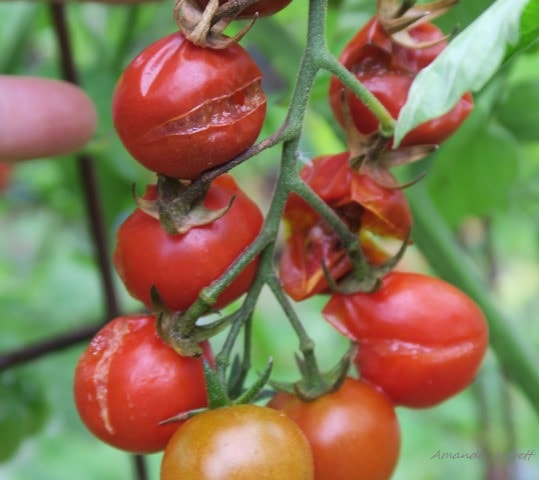
Keep soil evenly moist to prevent splitting.
|

Blossom end rot is caused by lack of water and calcium.
|
Potatoes: Harvest new baby potatoes when plants flower. Either pull out a few spuds or dig up the entire plant and harvest them all. To prevent green potatoes, keep them covered with soil. Plant seed potatoes for Christmas harvest.
To learn more about growing potatoes click here.
Late Blight of Potato & Tomato: Phytophthora infestans, is a serious global disease that affects tomatoes and potatoes worldwide. It was responsible for the Irish potato famine in the 1840’s and it is still a problem today. Water and wind spread the disease so protect plants with clear plastic cloches or grow in a greenhouse. Symptoms first appear as circular blotches on older foliage that yellows, wilts and drop off. Heat, humidity and rain promote this disease.
There’s no cure, so harvest only blemish free spuds and tomatoes, then destroy the plants and remove all plant parts from the soil to avoid reinfection. To prevent blight don’t plant any tomatoes and potatoes in that same spot, preferably for at least four years. Select resistant varieties, support plants with adequate cages, avoid overcrowding, avoid overhead watering and place mulch under tomato plants.
To learn more about growing potatoes click here.
Late Blight of Potato & Tomato: Phytophthora infestans, is a serious global disease that affects tomatoes and potatoes worldwide. It was responsible for the Irish potato famine in the 1840’s and it is still a problem today. Water and wind spread the disease so protect plants with clear plastic cloches or grow in a greenhouse. Symptoms first appear as circular blotches on older foliage that yellows, wilts and drop off. Heat, humidity and rain promote this disease.
There’s no cure, so harvest only blemish free spuds and tomatoes, then destroy the plants and remove all plant parts from the soil to avoid reinfection. To prevent blight don’t plant any tomatoes and potatoes in that same spot, preferably for at least four years. Select resistant varieties, support plants with adequate cages, avoid overcrowding, avoid overhead watering and place mulch under tomato plants.

cover exposed potatoes to prevent them from turning green.
|

Harvest new potatoes when plants are in flower.
|

Tomato blight is caused by warm, humid weather and rain.
|

Blight affects the lower leaves first.
|

Destroy infected fruit and don't place in the compost.
|
Onions, garlic, shallots: To encourage big bulbs, snip off their flowers (scapes) but don’t throw them out. Harvest the scapes and make pesto or add to stir fries. Stop watering when their leaves flop over and harvest when their leaves turn brown. Cure bulbs in a shaded, dry, and cool place, away from full sun. This tightens the outer layers, which protects the bulb. Once cured, store in a dry, cool and dark location.
Rhubarb & Asparagus: Cut off flowers from rhubarb plants as soon as they appear. Stop harvesting rhubarb and asparagus so they can prepare for next year's harvest.
Rhubarb & Asparagus: Cut off flowers from rhubarb plants as soon as they appear. Stop harvesting rhubarb and asparagus so they can prepare for next year's harvest.

Quit harvesting asparagus for a good harvest next year.

Garlic scapes are also edible.
|

Cut off any flowers from rhubarb flowers and stop harvesting the stalks.

Wait for garlic foliage to brown before harvesting.
|
Plant Your Winter Veggies: Sow seeds of winter hardy plants: broccoli, cauliflower, carrots, cilantro, kohlrabi, kale and cabbage. Plant where the soil drains well so they don't rot with winter rains. Protect plantings from insects with a cloche covered with floating row covers that will also keep them a tad warmer. In fall, add a layer of straw to insulate the soil from the cold. For more click on Winter Veggie Gardening or Cloches - Growing Food - Crop Rotation, Succession & Companion Planting - Harvesting - Growing Potatoes
Help Pollinators: Instead of harvesting all your carrots broccoli, lettuce, beets, radishes and other non-fruiting veggies, allow some to remain so they will eventually flower. Bees, butterflies and other pollinators love their simple blossoms. Not only are you helping pollinators, you get free seeds. For more click on Harvesting Seeds & Helping Pollinators.
Help Pollinators: Instead of harvesting all your carrots broccoli, lettuce, beets, radishes and other non-fruiting veggies, allow some to remain so they will eventually flower. Bees, butterflies and other pollinators love their simple blossoms. Not only are you helping pollinators, you get free seeds. For more click on Harvesting Seeds & Helping Pollinators.

Alison's winter veggie patch is on its way last August. Click on pic for more.
|

A cloche protects winter crops. Click on pic for more.
|
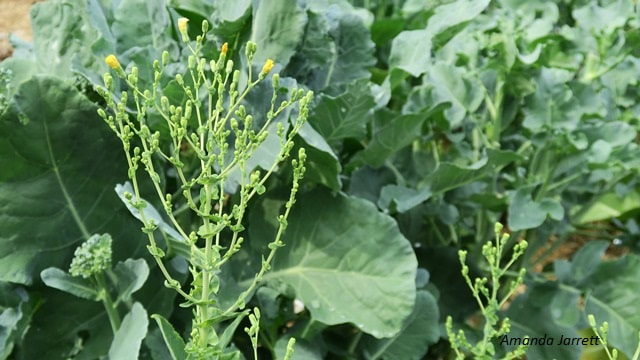
Pollinators love lettuce flowers, resulting in free seeds. Click on pic for more.
|
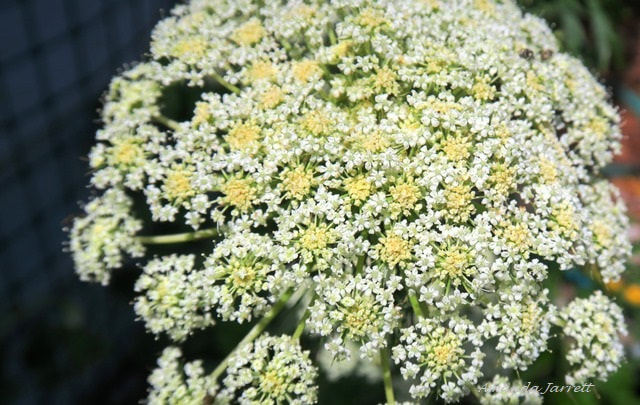
A carrot flower is not only pretty, pollinators love them too. Click on pic for more.
|
Composting: To avoid smelly compost and rats, don’t add meat, fat, cooked or processed food including rice and bread. Rinse out un-cooked eggshells before crushing them before adding them to the compost. Only add raw veggie scraps, coffee grounds, tea leaves, disease and insect free plants and plant parts. Give the pile a good turn and water when dry. It should be as moist as a wrung out sponge. For more on composting, click here.

Use torn up newspaper for a carbon layer in the compost pile.
|

Only add raw veg, fruit and garden debris. No cooked food, fat, meat or bones.
|

Always top the compost with dried leaves, newspaper or soil.
|
Powdery Mildew: This white, powdery residue that infects cucumbers, melons, squash, roses, garden phlox and other plants is a fungus called powdery mildew. It first appears on new foliage and flower buds. Keep water off the foliage of susceptible plants and don’t allow soil to dry out. To control this fungus, click here for two safe, organic sprays made from baking soda and milk. They work!
Japanese Beetles: Potatoes, beans and apple trees are a few of the many plants that are susceptible to this common plant pest. The feed on the tender tissues between leaf veins. To learn more, click on Japanese Beetles.
Japanese Beetles: Potatoes, beans and apple trees are a few of the many plants that are susceptible to this common plant pest. The feed on the tender tissues between leaf veins. To learn more, click on Japanese Beetles.
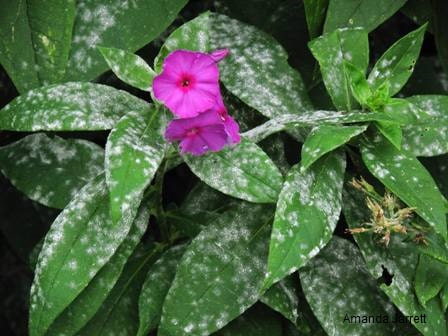
Powdery mildew is common garden phlox disease.
|
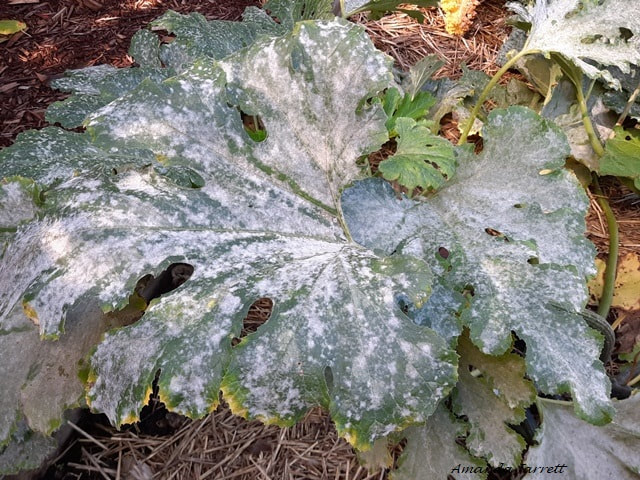
A zucchini leaf covered in powdery mildew.
|

There organic homemade recipes to control powdery mildew.
|

Japanese beetle damage on a potato leaf. Click on the pic for more.
|
Summer Rose Care
Deadheading & Cutting Roses: Remove spent blooms and roses for floral arrangements by cutting the stems just above an outward facing leaf that has 5 to 7 leaflets. For more on pruning roses click here.
After Each Flush of Blooms: Water well and fertilize with kelp meal, seaweed extract or fish fertilizer to promote healthy growth and more blossoms. Enrich the soil with an inch or two of compost mixed in around the roots. Top it off with a 3-inch layer of mulch. To promote more blossoms, apply a high phosphorous fertilizer (middle number highest ex: 6-8-6).
Black spot on Roses: Remove infected leaves from the soil and plant. Follow up with an application with organic fungicides: neem oil, sulfur and copper. For more info click on Rose Insect & Diseases - Roses - Types of Roses - Easy Roses - Pruning Roses - Rose Sawfly - Rose Bloom Balling
Deadheading & Cutting Roses: Remove spent blooms and roses for floral arrangements by cutting the stems just above an outward facing leaf that has 5 to 7 leaflets. For more on pruning roses click here.
After Each Flush of Blooms: Water well and fertilize with kelp meal, seaweed extract or fish fertilizer to promote healthy growth and more blossoms. Enrich the soil with an inch or two of compost mixed in around the roots. Top it off with a 3-inch layer of mulch. To promote more blossoms, apply a high phosphorous fertilizer (middle number highest ex: 6-8-6).
Black spot on Roses: Remove infected leaves from the soil and plant. Follow up with an application with organic fungicides: neem oil, sulfur and copper. For more info click on Rose Insect & Diseases - Roses - Types of Roses - Easy Roses - Pruning Roses - Rose Sawfly - Rose Bloom Balling

Oso Happy Smoothie rose has few if any thorns and is easy to grow. Click on pic for more.
|

Cut off flowers just above a 5 or 7 leaflet leaf.
|

Squish aphids as you hose them off.
|

Certain types of roses are prone to blackspot.
|

Remove all dead rose canes at their base.
|
Containers, Planters, Window Boxes, Hanging Baskets
Daily attention is needed to ensure they are receiving adequate water and nutrients. For seriously dried out planters etc., submerge them in a bucket of water until the bubbling stops. Slow release fertilizers that were added to the soil upon planting may have been used up. Yellow foliage and lack of vigour are symptoms of hunger so feed with a fertilizer fish or kelp or other liquid fertilizers for a quick fix. Cut back tired annuals by half so they will reflower. For more click on Container Growing.
Daily attention is needed to ensure they are receiving adequate water and nutrients. For seriously dried out planters etc., submerge them in a bucket of water until the bubbling stops. Slow release fertilizers that were added to the soil upon planting may have been used up. Yellow foliage and lack of vigour are symptoms of hunger so feed with a fertilizer fish or kelp or other liquid fertilizers for a quick fix. Cut back tired annuals by half so they will reflower. For more click on Container Growing.

This yellowish tuberous begonia is lacking nitrogen.
|

Leggy marigolds need to be cut back.
|

The plants underneath the marigolds are finally revealed.
|

Set a shallow dish filled with water for pollinating insects.
|
July's Arrangement

July 2024
July's cut flowers include hydrangeas, feverfew, hosta and leek flowers. For a numbered guide to the specific flower names and for other arrangements go to Monthly Flower Arrangements
Plant of the month
Catalpas

The incredible flowers of a catalpa never disappoint.

A perfectly shaped catalpa in full flower. Nice.

Under the canopy the attractive branching structure is revealed.

Catalpa flowers resemble very large snapdragons.

Flower clusters are huge.

Flowers are held upright in showy clusters.

Catalpas look good even without their flowers.

Catalpas have a very pleasing shape.

Flowers and their seed pods.

Heart-shaped leaves grow up to 12 inches long and 8 inches wide.

Slender seed pods persist until the following year.
|
Common Name: Catalpas, cigar tree, Catawba, Indian bean tree
Botanical Name: Catalpa speciosa, C. bignonioides Form: upright, symmetrical, broad, rounded crown (canopy) Family: Bignoniaceae Genus: Catalpa Species: speciosa, bignonioides Plant Type: deciduous tree Mature Size: 40–60 ft (12–18m) x 20–40 ft (6–12m) Growth: fast Origin: C. speciosa: midwestern USA, C. bignonioides: southeastern United States Hardiness Zone: C. speciosa - 4 to 8, C. bignonioides – 5 to 9 Foliage: light to yellowish green, heart-shaped, broadly oval to round with pointed tips, up to 12” long and 8” wide, dense hairs on leaf undersides Flowers: large, white snapdragon-like, yellow & purple inside, held in large upright clusters (panicles) up to 10” high Fruit: 12 – 22-inch-long seedpods that resemble brown cigars at maturity that split lengthwise releasing small black viable seeds Trunk: grey-brown, mature trees ridged and fissured Exposure: sun to partial shade Soil: moist, with good drainage Uses: specimen, accent, shade tree Attracts: bees, butterflies Propagation: seeds, cuttings Pruning: late winter Problems: brittle branches, powdery mildew, verticillium wilt, twig blight, catalpa sphinx moth, messy seedpods Comments: Catalpas are no shrinking violets. They turn heads when in bloom and are admired for their splendid form when they are not. Catalpas are medium sized deciduous trees with a broad canopy that bears huge flower clusters amid heart shaped leaves. Catalpas are indigenous to the United States. There are two species, Catalpa speciosa, the northern catalapa and C. bignoides, the southern catalapa. Although they look the same, the northern catalpa hales from the Midwest USA. It’s hardier and bigger than its sibling the southern catalpa that originates from the southeast. Catalpas are known for their bodacious tropical look with their 2-inch ruffled snapdragon-like flowers. The many blossoms sit proudly around a central stem. Flower clusters are huge, up to 10 inches tall. Individual blossoms are white with purple and pink markings inside the flower. Each blossom is beautiful, but they are jaw-droppingly gorgeous when clustered together on upright panicles that pop up all over the tree. Flowering occurs in summer around June and July. The flowers are soon replaced by long green pods that dangle down like narrow slender brown cigars upon maturity, hence their common name the cigar tree. The pods can reach up to 22 inches in length and each contain numerous seeds. Although their seeds are viable, seedlings do not pop up everywhere so they are not considered invasive. Even without it’s magnificent flowers and dangling pods, the catalpa looks pretty darn attractive because of its pleasing rounded canopy. It’s branches stretch like arms embracing the impressive soft green heart-shaped foliage that can grow to 12 inches in length and up to 8 inches wide. In autumn, they turn yellow, providing another season of interest. Even in winter they still manage to garner attention with their beautifully rounded form and perfect ‘bones’. To grow these magnificent trees, provide them with moist soil with good drainage as their indigenous habitat typically occurs along streams and riverbanks. They don’t like dry, arid conditions. When planting, mix in lots of compost and add a 3-inch layer of an organic mulch to reduce soil evaporation. Grow from Seed: To grow them from seeds, collect seed pods when they turn brown. Place the seedpods in the fridge in a paper envelope until spring. Open the pods and bury each seed by ¼ inch in potting soil, water and keep moist. They should germinate in about 3 weeks. 
Catalpa's fall foliage is a brilliant yellow.

Participants at a tree tour at Riverview Arboretum shows the breadth of a mature catalpa.

Flowers sit above the foliage.

There are multiple individual wavy seeds in each seed pod.
|

This ginormous catalpa part of the impressive tree collection at Riverview arboretum. Click on the pic to be redirected.
|
|
|
THE GARDEN WEBSITE INDEX
Click on the links below to be redirected.
for the tropical Gardener

While working in Florida as horticultural consultant, it became apparent that there was a need for a book on tropical shrubs. There are so many wonderful shrubs to choose from, so I wrote a reference book to make the selections easier. Ornamental Tropical Shrubs includes pictures in full colour and information about the plants in point form. So if you live in the tropics and subtropics and need a reference book on tropical shrubs, or you just want to have a look-see click here.
|
|
Copyright 2017 The Garden Website.com, Amanda's Garden Consulting Company - All Rights Reserved